
France 2030: ALSEAMAR and CNRS Deploy a Record-Breaking Fleet of 10 SEAEXPLORER Underwater Gliders in the Mediterranean
June, 17th 2026
France 2030: ALSEAMAR and CNRS Deploy a Record-Breaking Fleet of 10 SEAEXPLORER Underwater Gliders in the Mediterranean
June, 17th 2026
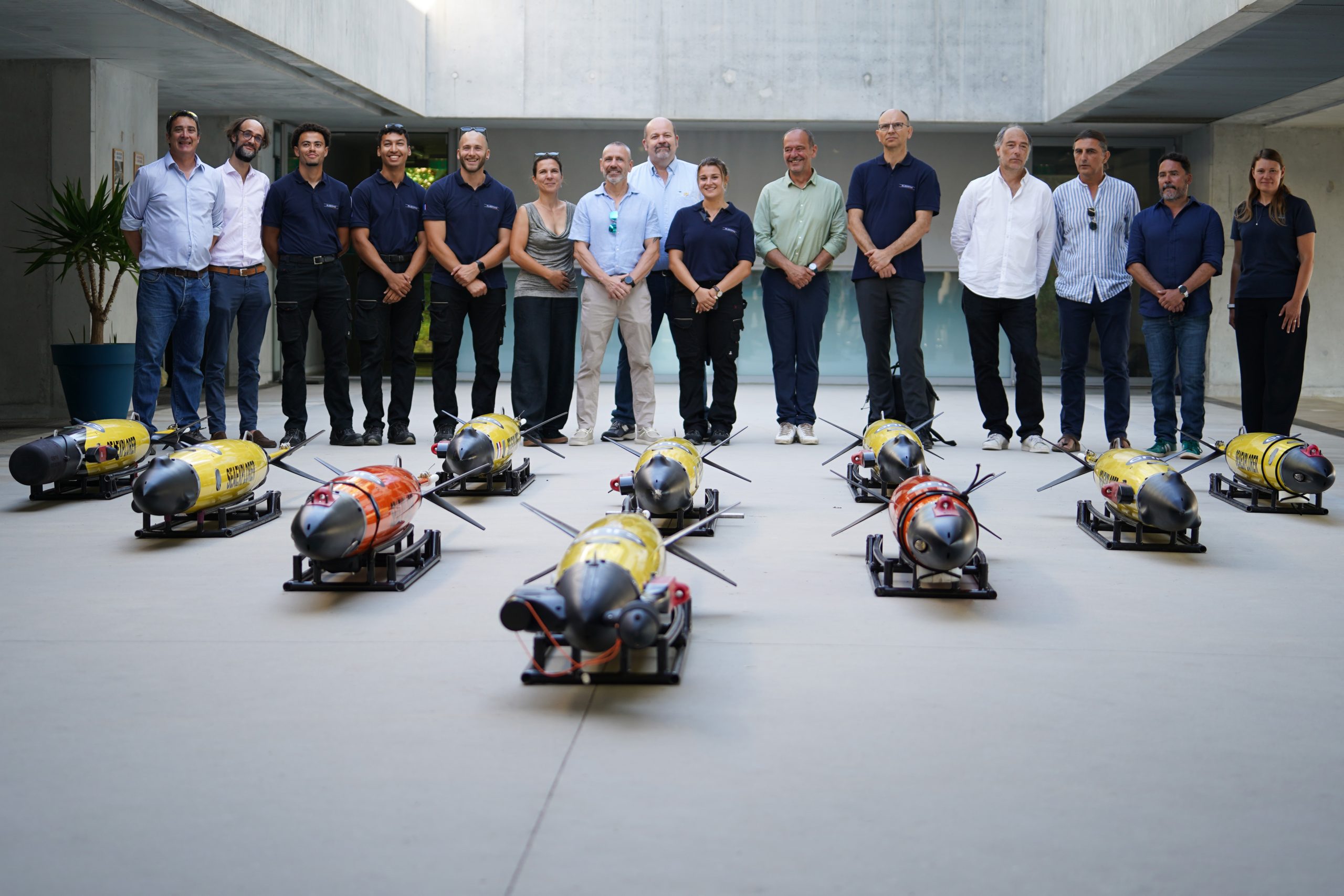
On June 17, 2026, CNRS and ALSEAMAR launched a major scientific mission in the Ligurian Sea as part of the France 2030 program. Over the course of one month, a fleet of 10 autonomous SEAEXPLORER underwater gliders will collect environmental data to improve our understanding of marine ecosystems and the impact of fine-scale oceanographic processes.
This represents the largest fleet of autonomous underwater gliders ever deployed simultaneously and in a coordinated manner in Europe for a scientific data collection mission.
A Mission Supporting the Ambitions of France 2030
Announced by French President Emmanuel Macron in October 2021, the France 2030 funding programs aims to strengthen France’s industrial competitiveness and accelerate the development of futures technologies.
Among the program’s ten strategic goals is Objective No. 10: “Investing in the Exploration and Knowledge of the Seabed.”
Within this framework, CNRS (Centre National de la Recherche Scientifique) is leading Mission 6, which focuses on the creation of an environmental data atlas for the northwestern Mediterranean Sea.
The mission relies on autonomous underwater gliders capable of monitoring the ocean over extended periods and providing essential data to improve our understanding of marine ecosystems.
Mobilizing a Fleet of 10 SEAEXPLORER Gliders
To carry out this mission, CNRS has entrusted ALSEAMAR with the deployment and operation of a fleet of 10 SEAEXPLORER underwater gliders.
Launched on June 17 from the Villefranche-sur-Mer Oceanographic Institute, the vehicles will operate in the Ligurian Sea for one month following a coordinated navigation plan.
This operation is unprecedented in Europe in terms of scale, involving the simultaneous deployment of ten autonomous underwater gliders operating in coordination within a single scientific mission.
To Better Understand Fine-Scale Ocean Processes
One of the mission’s primary scientific objectives is to investigate how oceanographic structures influence the distribution of zooplankton communities.
Although these processes are often difficult to observe using traditional methods, they play a critical role in marine ecosystem functioning, nutrient transport, and biodiversity distribution.
Among the ten SEAEXPLORER gliders, five will carry out acoustic measurements, while the remaining five will collect physical and biogeochemical data.
Together, these observations will help characterize fine-scale ocean structures and provide new insights into their influence on the marine environment.
And Contribute to the Major Challenges of Ocean Conservation
This mission is part of a broader international effort to enhance knowledge of the marine environment and strengthen ocean conservation initiatives.
The “Seabed” goal of the France 2030 program is closely aligned with the ambitions of the Biodiversity Beyond National Jurisdiction (BBNJ) Agreement, which entered into force in January 2026 following the United Nations Ocean Conference (UNOC).
By deploying its autonomous underwater glider technology in support of scientific research, ALSEAMAR is contributing to the collection of critical data needed to better understand marine ecosystems, monitor their evolution, and support initiatives aimed at protecting our ocean heritage.
About the France 2030 Funding Programs
A dual ambition: to sustainably transform key sectors of the French economy—such as health, energy, automotive, aeronautics, and space—through technological innovation, and to position France not only as a participant but as a leader in shaping the world of tomorrow.
From fundamental research to the emergence of new ideas and the industrialization of innovative products and services, France 2030 supports the entire innovation lifecycle.
Unprecedented in scale: €54 billion will be invested to help French companies, universities, and research organizations successfully navigate transitions in strategic sectors.
The goal: to strengthen their ability to compete globally, address environmental challenges, and foster the next generation of industrial leaders. France 2030 dedicates 50% of its funding to decarbonization efforts and 50% to emerging innovators, with no expenditure harmful to the environment, in line with the Do No Significant Harm principle.
A collective approach: designed and implemented in close collaboration with economic, academic, local, and European stakeholders to define strategic priorities and flagship initiatives. Project leaders are invited to submit proposals through open, rigorous, and selective calls for projects to receive state support.
Governance: France 2030 is overseen by the General Secretariat for Investment on behalf of the Prime Minister and implemented by ADEME, the French National Research Agency (ANR), Bpifrance, and the Caisse des Dépôts et Consignations.
More information: france2030.gouv.fr
In Partnership with:

With the Support of:
